DUNHILL Shell 5102

DUNHILL Shell 5102

England, 1991

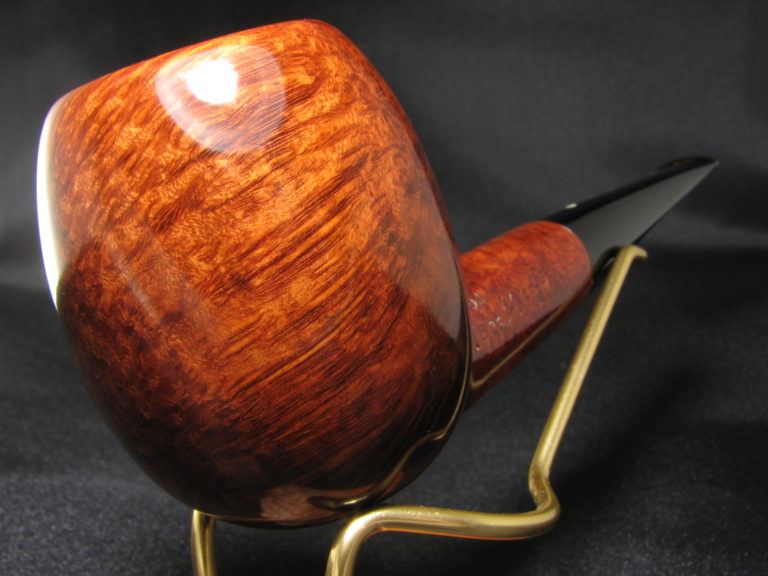
A really large (“5” was one of the largest group size in the serial production), really traditional (02 – is one of the oldest and respected Dunhill shapes) and really impressing by its size, shape, grain and condition Dunhill Shell from 1991.

The pipe marking is “5102”, “DUNHILL SHELL \ MADE IN ENGLAND 31”. The length is 14.7 cm (5.79″), bowl’s height is 5.4 cm (2.12″). External diameter of the bowl is 3.9 cm (1.54″), internal diameter is 2.1 cm (0.83″). The depth is 4.8 cm (1.89″) and this pipe weights 58 gr. Briar, vulcanite stem, no filter. There was a small surface chunk split off on the shank, we’ve put it back and fixed with a strong super glue – almost invisible.

Similar Posts

  • DUNHILL Root Briar 418

    England, 1960s A very nice example of the top grade Dunhill series. Usually the absense of the year suffix means the pipe was made in 1960 according to some experts. Of course if it’s not a patent period pipe. However the most interesting detail of this pipe is the skillfully replased shank. The quality of…

  • DUNHILL Bruyere 767, 1972-74

    England, 1972-74 In the beginning Dunhill created Bruyere. And several years (1910-1917) it was the single brand made by the company of a firm and dense Calabrian briar. And though pre WWII “bruyeres” were marked just by a letter “A” instead of model, the Bruyere series is the one of the oldest long-livers not only…

  • DUNHILL Cumberland 3103

    England, 2003 The “Cumberland” series is relatively young in comparison to other lines – it was introduced in 1979 and named in honor of Cumberland Street – the street where production and warehouse capacities of the company existed comfortably for many years. But such brindle ebonite stems (“cumberland” stems – also a Dunhill’s invention!) make…

  • DUNHILL Tanshell 142

    England, 1966 The Dunhill Tanshell series is a child of stormy 1950-60s. Due to a difficult political situation in Algeria supply of Algerian briar was temporally suspended. The situation was used by Dunhill as a good chance to try Sardinian briar and to use own patented deep sandblast technique.  The material is significantly much denser,…

  • DUNHILL Cumberland 41022

    England, 1982 Even if Dunhill didn’t obtain a patent for usage of brindle ebonite for stems, their input in promoting of a new material and invention of a suitable and well memorable name for it is undoubted. The name was born in 1979, when a new series of sandblasted pipes with modern stems was christened…

Leave a Reply

Your email address will not be published. Required fields are marked *