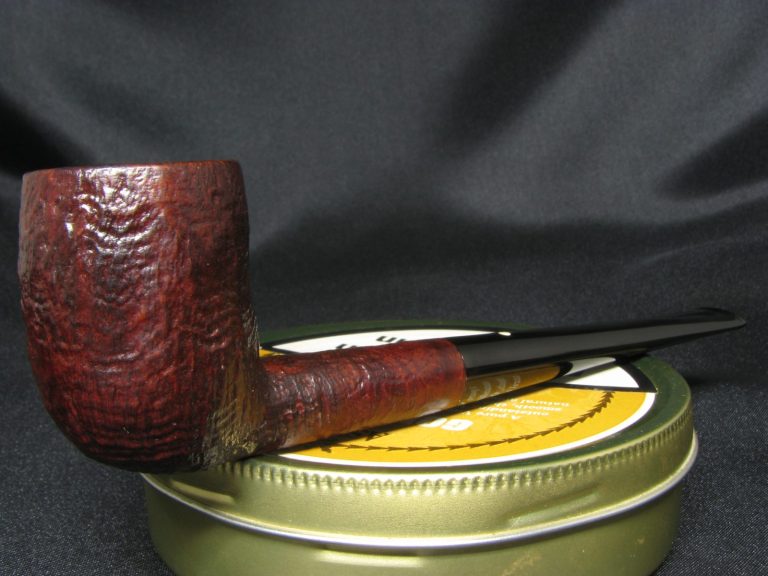
DUNHILL Chestnut 41022

DUNHILL Chestnut 41022

England, 1983

A younger sister of Dunhill Cumberland. “Cumberlands” have been started to be produced in 1979 on the occasion of closing of warehouses on Cumberland Road. The series was very popular and in 1983 Dunhill decided to start a smooth  version of this series  – a “Chestnut”. Surely, you won’t mistake its family trait – an unusual cumberland stem. A convincing Chestnut bent exactly from 1983!

The pipe markings are “DUNHILL \ CHESTNUT”, “41022”, “MADE IN \ ENGLAND 23”. The length is 14.5 cm, bowl’s hight is 5.0 cm. External and internal diameters of the bowl are 3.8 cm and 2.0 cm. The depth is 4.2 cm and this pipe weights 44 gr. Briar, cumberland stem, no filter.


Similar Posts

  • DUNHILL Dress 4114

    England, 2004 Dunhill Dress pipes are relatively young; the series was introduced in 1973 and is distinguished by dark (in the most cases black) smooth finish. Despite the dark stain is hiding natural briar grain the “Dress” pipes look luxurious indeed!

  • DUNHILL Cumberland 3103

    England, 2003 The “Cumberland” series is relatively young in comparison to other lines – it was introduced in 1979 and named in honor of Cumberland Street – the street where production and warehouse capacities of the company existed comfortably for many years. But such brindle ebonite stems (“cumberland” stems – also a Dunhill’s invention!) make…

  • DUNHILL Dress 51033

    England, 2002 Dunhill Dress pipes are relatively young; the series was introduced in 1973 and is distinguished by dark (in the most cases black) smooth finish. Despite dark stain hides natural briar grain the “Dress” pipes look luxury indeed!

  • DUNHILL Red Bark 114

    England, 1972 Red Bark is perhaps the best-known and valued Dunhill series among other “retired”. The Red Bark pipes were produced not for a long time – from 1972 to 1987, and in fact, they are traditional sandblasted Dunhills, but smokers and collectors are still attracted by these pipes and their unusual staining. By the…

  • DUNHILL Cumberland 41022

    England, 1982 Even if Dunhill didn’t obtain a patent for usage of brindle ebonite for stems, their input in promoting of a new material and invention of a suitable and well memorable name for it is undoubted. The name was born in 1979, when a new series of sandblasted pipes with modern stems was christened…

  • DUNHILL Root Briar 4108

    England, 1978 Initially Dunhill didn’t pay any special attention to a grain of briar. Perhaps, the public opinion had not been ready yet to a “straight grain” and material of early Bruyere pipes didn’t differ by a remarkable grain. But in 1931 Root Briar series was started. The pipes were made of Corsican briar, wonderful…

Leave a Reply

Your email address will not be published. Required fields are marked *