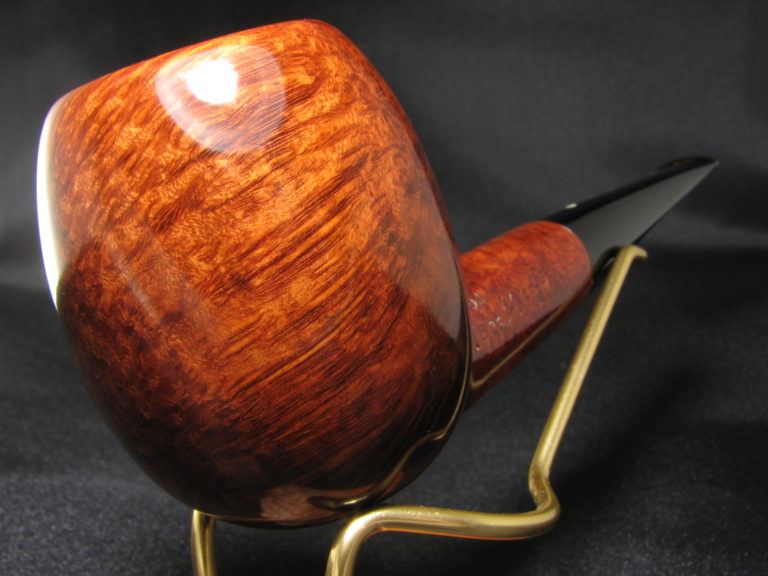
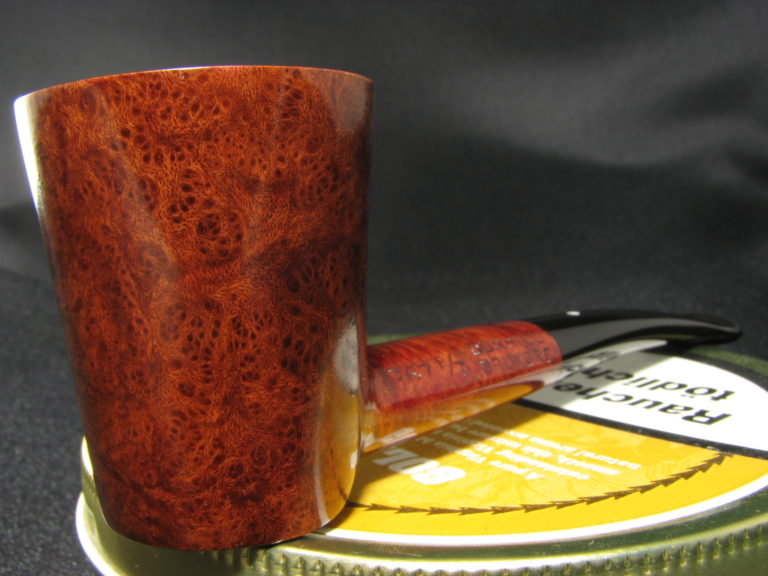
DUNHILL Bruyere bamboo

DUNHILL Bruyere bamboo

England, 1998

The idea of using bamboo came from the WWII times when supply of briar to the United kingdom faced a really dramatical shortage and the English manufacturers looked for any possibility to use different materials if not for the complete pipe making, but at least to compensate for the deficit of briar. Competent people say bamboo was firstly adopted by Dunhill to make shanks and soon it became a very popular option among other brands. Such pipes were named “Whangees” after the bamboo canes and umbrellas and they successfully remain popular and demanded until our days.

The pipe has no shape number stamped on it, but it definitely should be 4201 where 4 is the Group size, 2 – saddle stem (although today Dunhill is not very strict in using digits for stem shapes, we’ve seen saddle stem pipes with numbers 31.., 41 etc) and 01 – the apple shaped bowl.

The pipe markings are “(dunhill) \ BRUYERE \ MADE IN ENGLAND 38”, “(4)”. The length is 16.6 cm (6.54″) and the bowl’s height is 4.7 cm (1.85″). External diameter of the bowl is 3.8 cm (1.5″), internal diameter is 2.1 cm (0.83″). The depth is 4.0 cm (1.57″) and this pipe weighs 40 gr. Briar, vulcanite stem, no filter. The pipe was quite moderately smoked and very well preserved.

Similar Posts

  • DUNHILL Bruyere ODA N806

    England, 1972 The first Dunhill OD pipes (where OD stands for “Own Design”) were created long time ago in 1920s and they definitely weren’t a regular production series examples, rather some rare and therefore highly collectable quaint and oversized creatures. After the World War II Dunhill began expansion to new markets (first of all to…

  • DUNHILL Cumberland 3103

    England, 2003 The “Cumberland” series is relatively young in comparison to other lines – it was introduced in 1979 and named in honor of Cumberland Street – the street where production and warehouse capacities of the company existed comfortably for many years. But such brindle ebonite stems (“cumberland” stems – also a Dunhill’s invention!) make…

  • DUNHILL Tanshell 142

    England, 1966 The Dunhill Tanshell series is a child of stormy 1950-60s. Due to a difficult political situation in Algeria supply of Algerian briar was temporally suspended. The situation was used by Dunhill as a good chance to try Sardinian briar and to use own patented deep sandblast technique.  The material is significantly much denser,…

  • DUNHILL Bruyere 11781, 1979

    England, 1979 In the beginning Dunhill created Bruyere. And several years (1910-1917) it was the single brand made by the company of a firm and dense Calabrian briar. And though pre WWII “bruyeres” were marked just by a letter “A” instead of model, the Bruyere series is the one of the oldest long-livers not only…

  • DUNHILL Red Bark 53

    England, 1975 Red Bark is perhaps the best-known and valued Dunhill series among other “retired”. The Red Bark pipes were produced not for a long time – from 1972 to 1987, and in fact, they are traditional sandblasted Dunhills, but smokers and collectors are still attracted by these pipes and their unusual staining. By the…

  • DUNHILL Bruyere 767, 1972-74

    England, 1972-74 In the beginning Dunhill created Bruyere. And several years (1910-1917) it was the single brand made by the company of a firm and dense Calabrian briar. And though pre WWII “bruyeres” were marked just by a letter “A” instead of model, the Bruyere series is the one of the oldest long-livers not only…

Leave a Reply

Your email address will not be published. Required fields are marked *