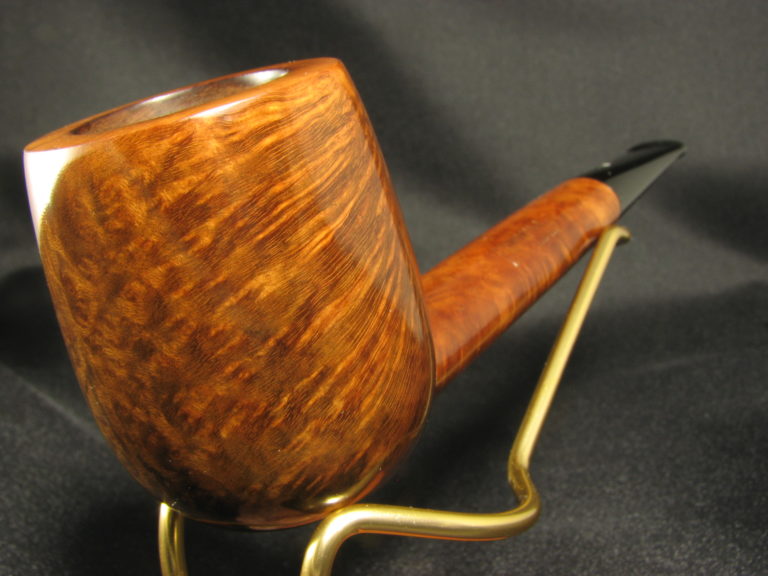
DUNHILL Shell Briar P, 1969

DUNHILL Shell Briar P, 1969

England, 1969

That’s a very rare sample of the Dunhill Shell Briar pipes stamped with a letter shape code instead of a number. Such codes were used at times ​prior to 1976 (according to Pipephil) and the shape “P” corresponds to “1/2 bent bulldog”. A unique collector’s finding!

The pipe markings are “P F/T”, “DUNHILL \ SHELL BRIAR”, MADE IN \ ENGLAND 9″, “(4) S” (hardly visible). The length is 14.4 cm (5.67″), bowl’s height is 4.1 cm (1.61″). External diameter of the bowl is 4.5 cm (1.77″), internal diameter is 2.1 cm (0.83″). The depth is 3.2 cm (1.26″) and this pipe weights 44 gr. Briar, vulcanite stem, no filter. The chamber has been protected with a break-in coat. The rim is not ideally flat but this doesn’t affect smoking qualities of course, rather it adds a unique charm to this exciting pipe!

Similar Posts

  • DUNHILL Root Briar 2000

    England, 2000 Let’s call it a “millenium pipe”. This attractive decent size (group 5) top grade Dunhills Root Briar pipe doesn’t have a shape number at all, but it says clearly it was made exactly in 2000. We assume the shape number should be 5113 (bent apple), but absence of this number makes the pipe…

  • DUNHILL Tanshell 142

    England, 1966 The Dunhill Tanshell series is a child of stormy 1950-60s. Due to a difficult political situation in Algeria supply of Algerian briar was temporally suspended. The situation was used by Dunhill as a good chance to try Sardinian briar and to use own patented deep sandblast technique.  The material is significantly much denser,…

  • DUNHILL Cumberland 3103

    England, 2003 The “Cumberland” series is relatively young in comparison to other lines – it was introduced in 1979 and named in honor of Cumberland Street – the street where production and warehouse capacities of the company existed comfortably for many years. But such brindle ebonite stems (“cumberland” stems – also a Dunhill’s invention!) make…

  • DUNHILL Root Briar 107 3R

    England, 1960s Unlike other competitors Dunhill’s approach to shapes and grades was pedantic and systematic indeed. Pipe smokers want variety. Which variety can we offer when all pipes are with the same white dot? First of all, a size (Group size from 1 till 6). Then a modification of a stem: tapered (0) or saddle…

  • DUNHILL Cumberland 41022

    England, 1982 Even if Dunhill didn’t obtain a patent for usage of brindle ebonite for stems, their input in promoting of a new material and invention of a suitable and well memorable name for it is undoubted. The name was born in 1979, when a new series of sandblasted pipes with modern stems was christened…

0 Comments

Leave a Reply

Your email address will not be published. Required fields are marked *