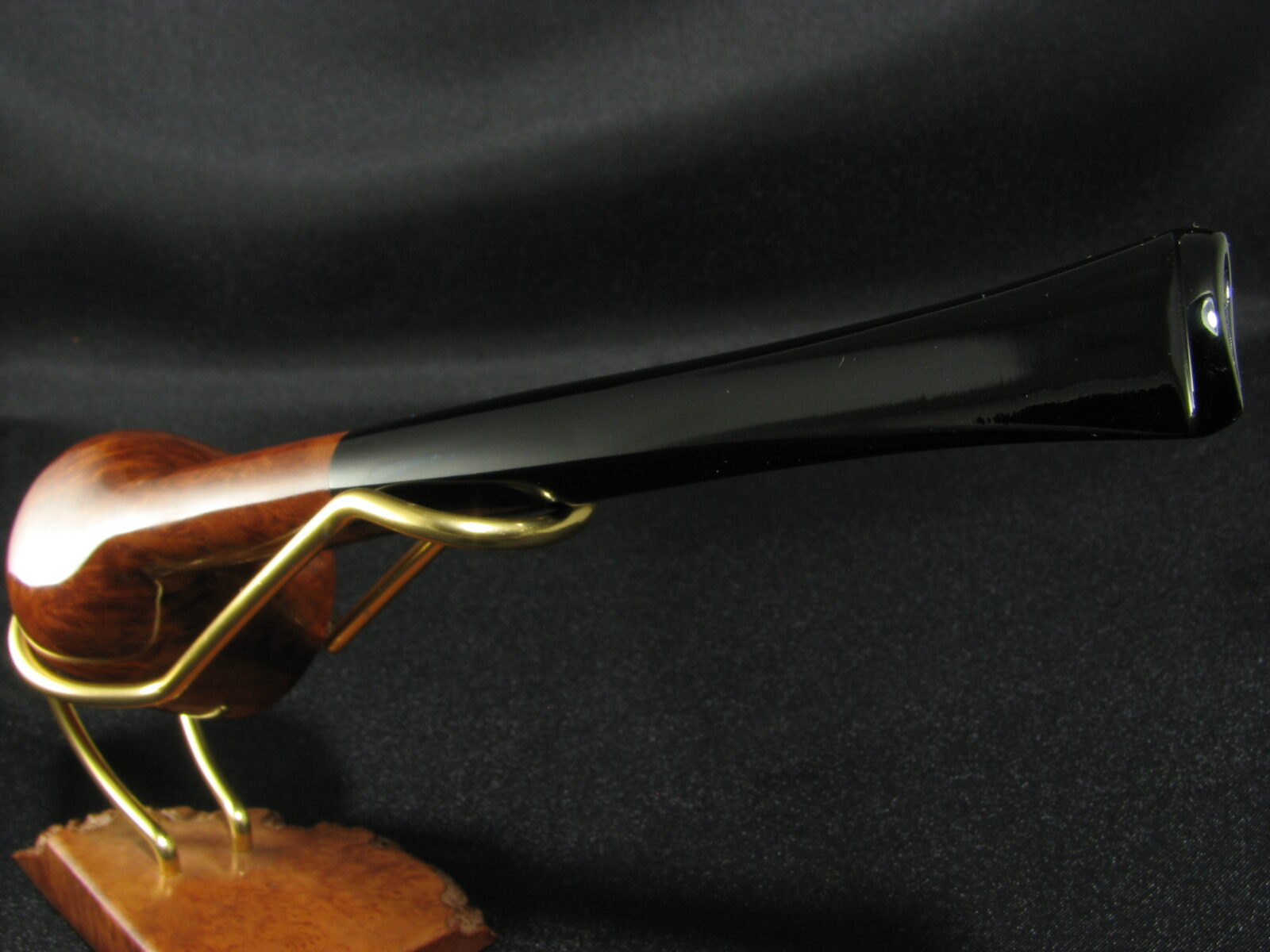
DUNHILL Root Briar 501, 1940

DUNHILL Root Briar 501, 1940

England, 1940

No staining just a natural finish! This is an exciting indeed example of the good old fashioned English pipe carving art. The pipe was made in 1940, already on the beginning of the Wold War II, but it shows the same approach, the same sense of taste and the same highest skills which made Dunhill a superstar in the smoking pipes Wold just from the very beginning!

The pipe markings are “R”, “DUNHILL \ LONDON”, “MADE IN ENGLAND 0”, “U.S. PATENT 1343253/20”, “501”. The length is 15.4 cm (6.06″), bowl’s height is 3.7 cm (1.46″). External diameter of the bowl is 3.6 cm (1.42″), internal diameter is 2.1 cm (0.83″). The depth is 3.2 cm (1.26″) and this pipe weights 27 gr. Briar, vulcanite stem, no filter. ​The stem is newly made of the fresh piece of vulcanite so we can consider the pipe as a “partially unsmoked” :-).

Similar Posts

  • DUNHILL Root Briar 83 (1968)

    England, 1968 Thanks to Dunhill’s clearness and punctuality – there’s everything crystal clear with this pipe dating and grading. This is the wonderful and lightweight Root briar pipe (the highest mass market grade) made in 1968. The shape number 83 is called a horn or a yacht – what you like more. Nice, amazing and…

  • DUNHILL Shell Briar 120

    England, 1962-63 It seems the pipe has two year suffixes – one (“2”) was printed after the word “England” and the second (“3”) is located a bit below it. A new year transition pipe? 🙂 Despite the Group Size 4 the pipe really impresses with its dimensions and the shape – a very stylish large…

  • DUNHILL Root Briar 572, (1960)

    England, 1960 A very fine example from the top-grade Dunhill series. Typically, the absence of the year suffix suggests that the pipe was manufactured in 1960, as indicated by some experts, unless it falls within a patent period. However, the most intriguing detail of this pipe is the expertly replaced shank. The quality of the…

  • DUNHILL Root Briar 5109

    England, 1986 Initially Dunhill didn’t pay any special attention to a grain of briar. Perhaps, the public opinion had not been ready yet to a “straight grain” and material of early Bruyere pipes didn’t differ by a remarkable grain. But in 1931 Root Briar series was started. The pipes were made of Corsican briar, wonderful…

  • DUNHILL Cumberland 41022

    England, 1982 Even if Dunhill didn’t obtain a patent for usage of brindle ebonite for stems, their input in promoting of a new material and invention of a suitable and well memorable name for it is undoubted. The name was born in 1979, when a new series of sandblasted pipes with modern stems was christened…

Leave a Reply

Your email address will not be published. Required fields are marked *