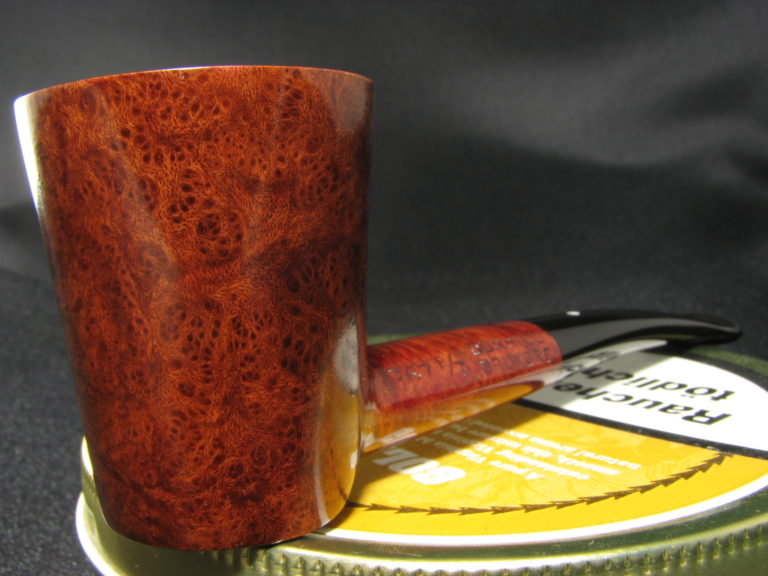
DUNHILL Root Briar 463
England, 1955
Sometimes even a little person can play an essential (if not solving) role in large-scale events. At least there are enough movies with such moral. The same we could say about small enterprises and their influence on development of pipe making art: even a small manufactory can leave its very and very notable trace.
John Louis Duncan founded his company in 1899 in Southport on the western coast of England. The manufactory didn’t become fantastically popular and large-scale. A few employees, a bowl turning facility and 2 or 3 sales representatives who traveled on the North of England and sold pipes literally from a car. Nevertheless Duncan Briars existed till 1990’s and was neither ruined nor absorbed by competitors. We have to admit that London and big industrial cities were quite far and there was, let’s say so, Duncan’s own territory.
It’s remarkable that yet in 1922 George Walker started with Duncan. 35 years later he left the company being the head foreman to found his own business – pipe repair named “Northern Briar pipes”. A bit later his son Ian will glorify “Northern Briars” as nearly the most skillful pipe carver in England.
It is also remarkable that in 1993-1996 Peterson’s owned the Duncan Briars – with intention to use it as the distributor in the UK and as contractor, including the bowl turning and supply.
But first of all the invention of a specific “dental” mouthpiece is associated with the name Duncan. Such construction should make smoking and holding of a pipe in teeth much more comfortable. Then this idea was picked up by many manufactorers – Falcon, GBD, and… yes, Dunhill too. So all text higher is not a mistake, it has a direct bearing to our today’s pipe. Moreover the pipe is one of the most nice periods and the highest grade.
The pipe markings are “DUNHILL \ ROOT BRIAR”, “463”, F/T”, “MADE IN \ ENGLAND 5”, “(2)”. The year suffix is already very hardly visible but you can identify it using a bright light. The length is 14.3 cm, bowl’s hight is 3.7 cm. External and internal diameters of the bowl are 3.5 cm and 1.8 cm. The depth is 3.0 cm and this pipe weights 32 gr. Briar, vulcanite stem, no filter. The chamber shows normal accurate use without burns or cracks, some insignificant darkening on the ream.