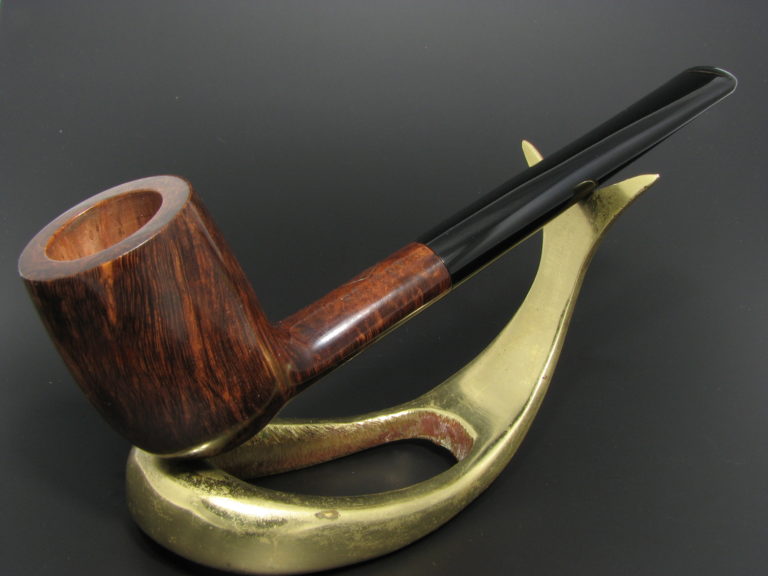
T. CRISTIANO Alfa 3 unmarked & unsmoked

T. CRISTIANO Alfa 3 unmarked & unsmoked

USA, 1980-90s

The pipe is from the T. Cristiano’s old stock. It was shaped and drilled approximately in 1980s, but finished nowadays. Tomas Cristiano was Italian by origin, his family emigrated to the USA in 1968 and several generations of Cristiano are involved into production and marketing of wonderful briar pipes. Thomas began at the S.M. Frank & Company factory – one of the “briar giants” of America, very quickly he made outstanding career and started own production of the brands T. Cristiano and Calabresi. Thomas’s pipes are in Italian way graceful and expressive and in American way well balanced in terms of a price / quality ratio.

​​​The pipe has no markings. The length is 13.3 cm (5.24″), bowl’s height is 5.2 cm (2.05″). External diameter of the bowl is 4.4 cm (1.73″), internal diameter is 2.0 cm (0.79″). The depth is 4.1 cm (1.61″) and this pipe weights 65 gr. Briar, vulcanite stem, no filter. ​The chamber has been protected with a break-in coat.

Similar Posts

  • COMOY’S Kent 309T unsmoked

    England, 1980s The shape number 309 is perhaps the most successful and popular Comoy’s canadian shape and became already a kind of a standard. Therefore we’re really happy to offer you this legendary, shiny, capacious and unsmoked (!)  Comoy’s canadian pipe made after 1980. The pipe markings are “COMOY’S / KENT”, “MADE \ IN \…

  • Lord Nelson unsmoked

    France, 1980-90s, unsmoked A nicely made (and still unsmoked!) French bent dublin pipe made approximately in the last decades of the XX century. Some sources claim the “Lord Nelson” brand was made by Comoy’s in England but the lily logo on the stem indicates its French origin, the most probably Chacom or some other St…

  • Lord Nelson bulldog

    France, unsmoked A nicely made (and still unsmoked!) French bent bulldog pipe made approximately in the last decades of the XX century. Some sources claim the “Lord Nelson” brand was made by Comoy’s in England but the lily logo on the stem indicates its French origin, the most probably Chacom or some other St Claude…

Leave a Reply

Your email address will not be published. Required fields are marked *