JELLING natural
USA
“If you must smoke, make it healthful and pleasurable.”
Details about David Jelling’s tobacco business are limited, with directories and catalogs providing little more than a brief mention of a tobacco shop in Newark that also sold pipes sourced from other suppliers.
More information can be gathered from artifacts of the era, primarily matchbooks and eyewitness accounts .
The business opened in 1919 in Newark and, over time, moved to several addresses. Earlier at 10 Clinton St and 486 Clinton Ave (the latter possibly an additional retail outlet), by the 1950s, it had settled at 14 Commerce St, where it remained until closing sometime in the mid-1970s. Of the listed addresses, only the two-story brick house on Clinton Ave survives, while the other areas have been significantly rebuilt.
It’s likely that David Jelling, whose signature appears on advertisements from the 1950s, was the founder of the business. For comparison, his business partner and pipe supplier, Louis Schoenleber, founded his pipe shop in the 1920s and lived until 1976. By the late 1960s, management had passed to Arthur Jelling, likely his son.
The clientele largely consisted of local lawyers, many of whom were cigar aficionados. Havana cigars were sold until 1959, but after the Cuban Revolution, advertisements became more discreet, and it’s unclear whether Havana cigars were still available.
The shop offered 20 different pipe tobacco blends under its own brand. These blends were made in-house by a tobacconist, with the process visible through a glass wall. One of the primary tobacco suppliers was Bloch Brothers of Virginia. Those who have sampled the blends report that they were comparable in quality to the classic Dunhill recipes.
The claim that Jelling pipes were handmade “by our expert craftsman” from imported briar might have been part of the marketing strategy, but it’s possible that, during better times, the shop employed a skilled craftsman. However, most sources point to Louis Schoenleber as the most important supplier and, in addition, orders for branded pipes in England and Denmark. The latter were usually marked HANDMADE DENMARK.
Cigarettes were neither sold nor welcomed at the Jelling shop.
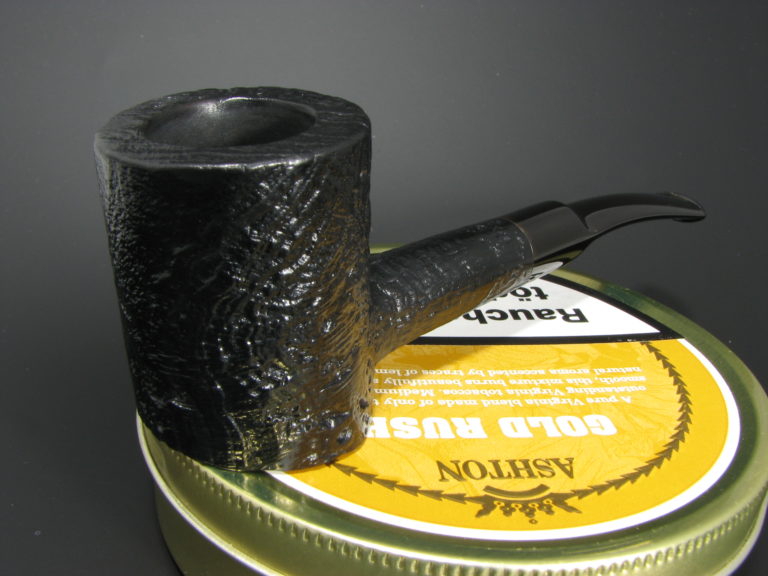
As for the today’s pipe, it is most likely a finely crafted, high-quality American piece. Threaded connections were particularly popular in the USA, making it a distinctive feature of the time.
Pipe markings “jelling \ NATURAL”
Length 13.5 cm (5.31″)
Bowl Height 4.9 cm (1.93″)
Outside Diameter 4.5 cm (1.77″)
Chamber Diameter 2.2 cm (0.87″)
Chamber Depth 3.6 cm (1.42″)
Weight 54 gr.
Briar, vulcanite stem, no filter.
The pipe is not for sale. It was restored to order and has already started a new life in a new cozy home.




Nice work. This shape is a Jobey Safari and looks to have the Jobey link too. Made at the Weber factory in NJ. I have a similar Shellmoor.