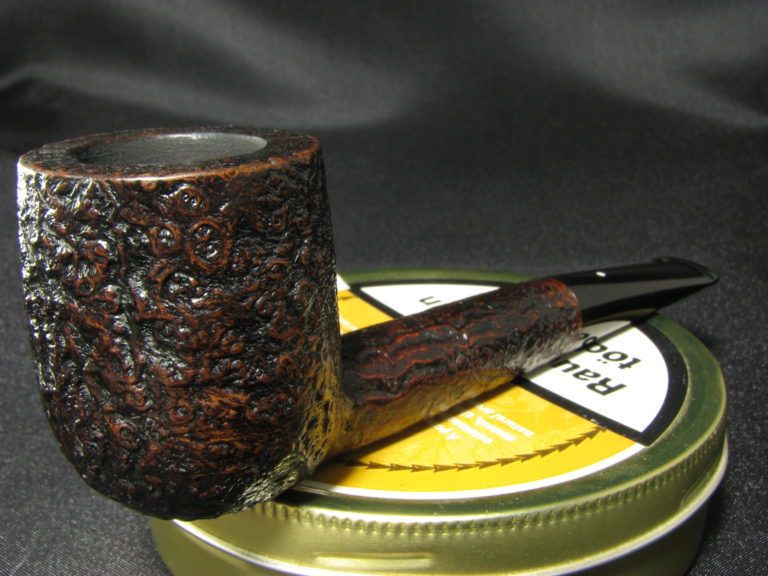
DUNHILL Root Briar 53 F/T

DUNHILL Root Briar 53 F/T

England, 1966

The top grade Dunhill pipe from 1966. Great pipe making period, elegant classical bent shape, patented fishtail (F/T) stem, almost no staining, moderately smoked condition – a real treasure!

The pipe marking is “53 F/T”, “DUNHILL \ ROOT BRIAR”, “MADE IN \ ENGLAND 6”, “(3) R”. The length is 12.4 cm (4.88″), bowl’s height is 4.4 cm (1.73″). External diameter of the bowl is 3.4 cm (1.34″), internal diameter is 1.8 cm (0.71″). The depth is 3.6 cm (1.42″) and this pipe weights 35 gr. Briar, vulcanite stem, no filter.

Similar Posts

  • DUNHILL Dress 51033

    England, 2002 Dunhill Dress pipes are relatively young; the series was introduced in 1973 and is distinguished by dark (in the most cases black) smooth finish. Despite dark stain hides natural briar grain the “Dress” pipes look luxury indeed!

  • DUNHILL Bruyere 60

    England, 1960s In the beginning Dunhill created Bruyere. And several years (1910-1917) it was the single brand made by the company of a firm and dense Calabrian briar. And though pre WWII “bruyeres” were marked just by a letter “A” instead of model, the Bruyere series is the one of the oldest long-livers not only…

  • DUNHILL Bruyere 42024

    England, 1979 An absolutely amazing pipe of the absolutely classical bent shape and absolutely comfortable size (Dunhill’s Group 4 pipes fit great both the aromatic and oriental (English) tobacco smokers’ needs) made by absolutely luxury manufacturer at the absolutely lucky times (the pipe comes from 1979). Lightly smoked, the chamber doesn’t have any substantial wear….

  • DUNHILL Root Briar 107 3R

    England, 1960s Unlike other competitors Dunhill’s approach to shapes and grades was pedantic and systematic indeed. Pipe smokers want variety. Which variety can we offer when all pipes are with the same white dot? First of all, a size (Group size from 1 till 6). Then a modification of a stem: tapered (0) or saddle…

  • DUNHILL Cumberland 31351

    England, 1981 Even if Dunhill didn’t obtain a patent for usage of brindle ebonite for stems, their input in promoting of a new material and invention of a suitable and well memorable name for it is undoubted. The name was born in 1979, when a new series of sandblasted pipes with modern stems was christened…

Leave a Reply

Your email address will not be published. Required fields are marked *