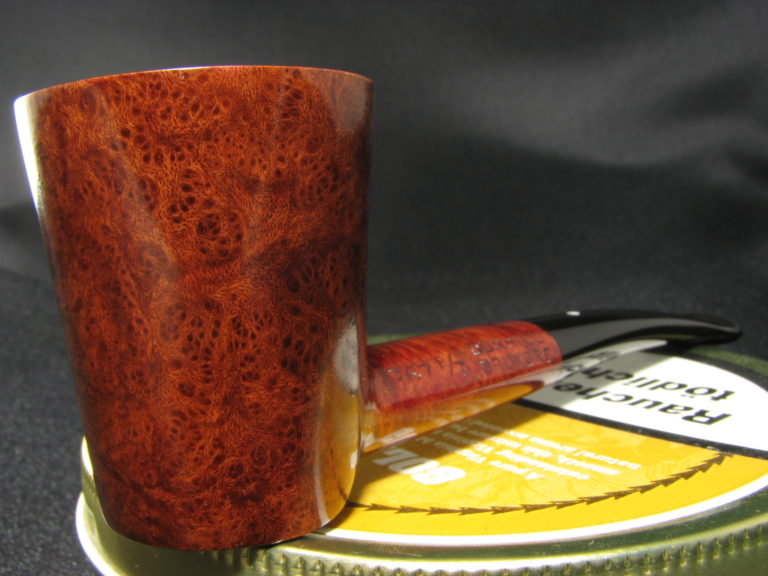
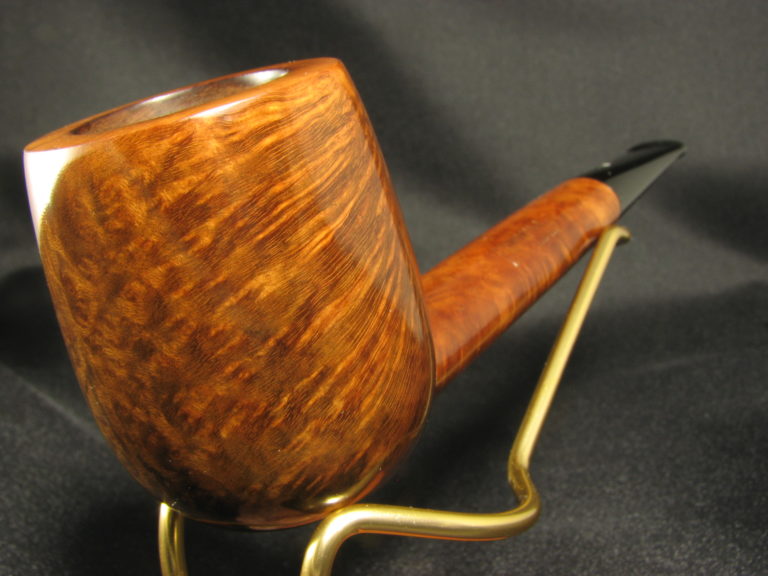
DUNHILL Red Bark 197, 1970s

DUNHILL Red Bark 197, 1970s

England, 1970s

Red Bark is perhaps the best-known and valued Dunhill series among other “retired”. The Red Bark pipes were produced not for a long time – from 1972 to 1987, and in fact, they are traditional sandblasted Dunhills, but smokers and collectors are still attracted by these pipes and their unusual staining. By the way, the color was also a subject to experiment – in some years Red Barks were brighter, later – darker again. Although we can’t identify the production year, it’s indeed a nice and affordable example of Dunhill’s art of pipes!

The pipe markings are “197”,”DUNHILL \ RED BARK”, “MADE IN \ ENGLAND “. The length is 15.4 cm (6.06″), bowl’s height is 4.2 cm (1.65″). External diameter of the bowl is 3.1 cm (1.22″), internal diameter is 1.9 cm (0.75″). The depth is 3.7 cm (1.46”) and this pipe weights 27 gr. Briar, vulcanite stem, no filter. The chamber has been protected with a break-in coat. The stem is newly made of the fresh piece of vulcanite so we can consider the pipe as a “partially unsmoked” :-).

Similar Posts

  • DUNHILL Cumberland 3103

    England, 2003 The “Cumberland” series is relatively young in comparison to other lines – it was introduced in 1979 and named in honor of Cumberland Street – the street where production and warehouse capacities of the company existed comfortably for many years. But such brindle ebonite stems (“cumberland” stems – also a Dunhill’s invention!) make…

  • DUNHILL Red Bark 53

    England, 1975 Red Bark is perhaps the best-known and valued Dunhill series among other “retired”. The Red Bark pipes were produced not for a long time – from 1972 to 1987, and in fact, they are traditional sandblasted Dunhills, but smokers and collectors are still attracted by these pipes and their unusual staining. By the…

  • DUNHILL Root Briar 4108

    England, 1978 Initially Dunhill didn’t pay any special attention to a grain of briar. Perhaps, the public opinion had not been ready yet to a “straight grain” and material of early Bruyere pipes didn’t differ by a remarkable grain. But in 1931 Root Briar series was started. The pipes were made of Corsican briar, wonderful…

  • DUNHILL Bruyere bamboo

    England, 1998 The idea of using bamboo came from the WWII times when supply of briar to the United kingdom faced a really dramatical shortage and the English manufacturers looked for any possibility to use different materials if not for the complete pipe making, but at least to compensate for the deficit of briar. Competent…

Leave a Reply

Your email address will not be published. Required fields are marked *