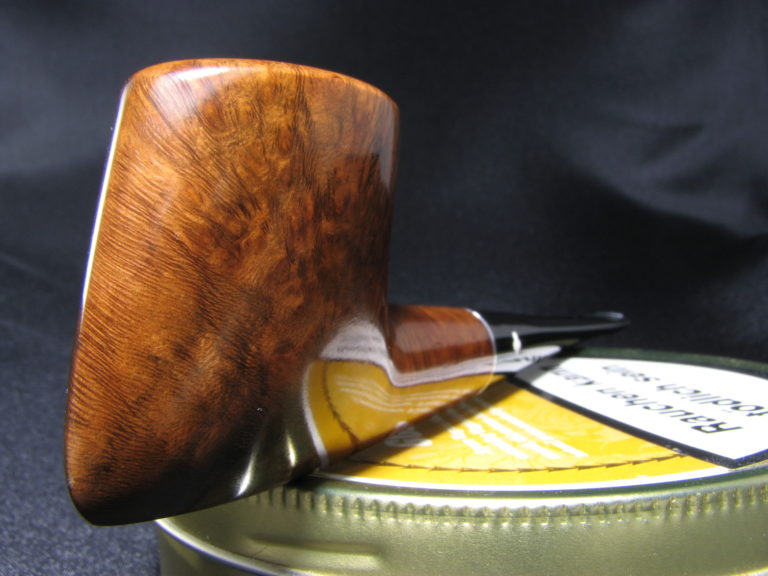
KAYWOODIE Super Grain lovat

KAYWOODIE Super Grain lovat

USA, 1960s

A lightweight and rare Kaywooodie pipe made in the middle of thr 1960s according to Kaywoodie experts.

The pipe markings are “KAYWOODIE \ Super Grain”. The length is 13.0 cm (5.12″), bowl’s height is 4.4 cm (1.73″). External diameter of the bowl is 3.2 cm (1.26″), internal diameter is 2.0 cm (0.79″). The depth is 3.4 cm (1.73″) and this pipe weights 30 gr. Briar, vulcanite stem, aluminium stinger. The air hole is a bit higher than a chamber’s bottom, nevertheless it’s a good pipe for test or extremal smoking – outside, fishing, hunting – anything you prefer 🙂 !

Similar Posts

  • KAYWOODIE Super Grain 29

    USA, 1930-50s Kaywoodie pipes are well known and respected as relatively inexpensive, reliable and collectable smokers, it’s perhaps the most collectable and well explored American pipe brand: each small detail can tell something significant about the pipe’s age and history. And this sample is very interesting indeed: this is the early Super Grain Kaywoodie (“Super…

  • KAYWOODIE Ruf-Tone

    USA, 1970-80s American artisans from Kaywoodie have always delighted collectors with a generous variety of shapes and finishes — sometimes simply pleasant and utilitarian, sometimes extremely apt and thoughtful. And, of course, our today’s Ruf-Tone belongs to such the brightest and most successful: the artificially aged, contrasting finish combined with deep rustication is literally mesmerizing,…

  • DUNHILL Shell 21111

    England, 1978 The sandblast finish is considered to be invented by Dunhill, at least this fact was confirmed with patents of 1917 – in Great Britain and 1920 – in the USA. From the beginning Algerian briar was used for blasted pipes as much softer and providing deeper and more attractive finish. Although in 1960-70…

  • KAYWOODIE Super Grain 61

    USA,1950s A very interesting Kaywodie pipe from 1950’s. Both the streamliner shape (so much popular at those times) and the technically advanced drilling approach make this sample a really collectable piece of American pipe making history. The drilling is done under the chamber with two drought holes down to bottom of the chamber in order…

Leave a Reply

Your email address will not be published. Required fields are marked *