Year: 2024

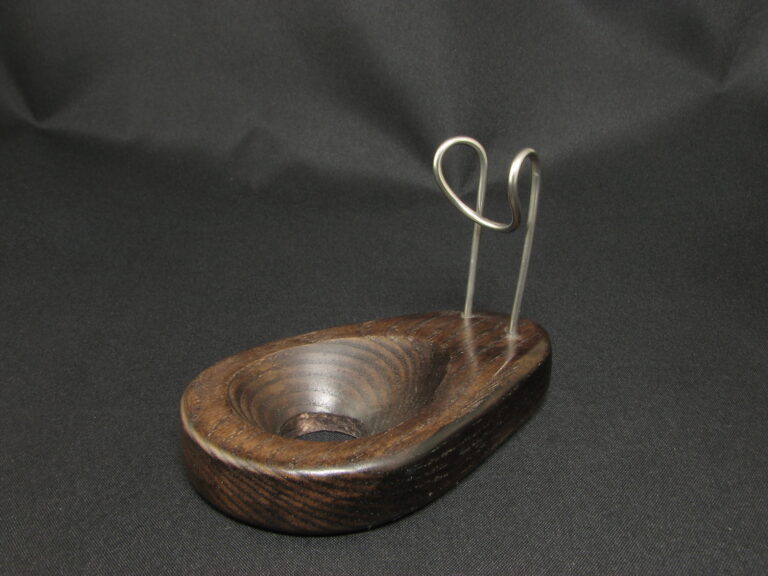
  • Pipe stand 1.3

    Ukraine This pipe stand was expertly crafted by Ukrainian artisans at the beginning of the century. It belonged to a warm and inviting home and was part of a well-established collection. Signs of use are minimal, a testament to its careful maintenance. Approximate Dimensions:Base: 8.8 x 5.4 cm (3.46 x 2.12″)Height: 6.0 cm (2.36″)Weight: 47…
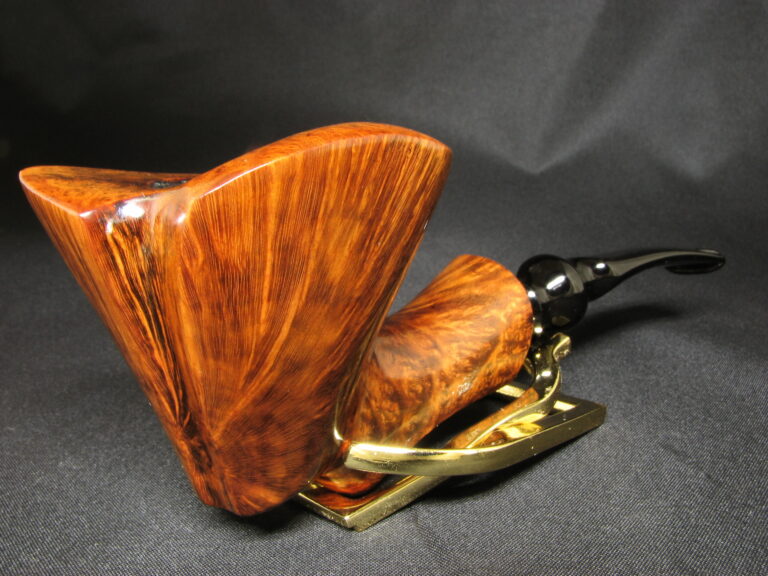
  • IIS

    Denmark, 1970s Authoritative sources attribute the authorship of IIS pipes to Karl Erik, a talented Danish craftsman, or to the renowned Preben Holm. In our opinion, this piece was most definitely crafted in the workshop of Karl Erik Ottendahl—the specific type of briar and the meticulous shaping that highlights the grain are clear indicators of…

  • ASCORTI New Dear

    Italy This piece is the work of Roberto Ascorti, a hereditary Italian artisan and son of Giuseppe ‘Peppino’ Ascorti, renowned for his contributions at Castello and as a co-founder of Caminetto. The artisan’s unique ‘New Dear’ finish is a play on contrasts, featuring deliberately rough rustication on the bowl—reminiscent of wax streaks—against a smooth shank…

  • BREBBIA Calabash Argento 2

    Italy This piece is another homage to traditional calabash pipes, crafted in a refined, expressive, and distinctly Italian style. Naturally, the manufacturer’s name adds an extra layer of charm to the creation. While Brebbia may not produce as many pipes as Savinelli—the leading Italian brand and, in a way, Brebbia’s ‘stepmother’—who ever said pipes are…

  • HARDCASTLE’S Jack O’London 17

    England, 1930-40s The series name, Jack O’London, and the marking BRITISH MADE transport us back to the distant, fairy-tale days when HARDCASTLE’S was still a family-run manufactory, and Alfred Dunhill, though gradually moving toward full ownership, had not yet influenced production or marketing. Here, we have an artifact of English culture from the 1930s and…

  • GBD Granitan 256

    England, 1950-70s The success story of GBD lies not only in the careful selection of high-quality raw materials and expert craftsmanship—though, of course, these are essential. It’s also a matter of combinatorics: developing dozens of classic and unconventional shapes, creating numerous series and sub-brand names, and applying a wide array of finishing techniques, both traditional…

  • AMPHORA X-tra 728-848

    Netherlands, 1980s Sooner or later, many pipe manufacturers come up with the idea of selling tobacco under their own brand. Dunhill, Peterson, and Ashton, among others, have done so, and the list could go on. Rarer, however, is the case where a pipe appears as an addition to an established tobacco brand, extending the trademark…

  • KAYWOODIE Super Grain 61

    USA, 1950s We restored the same 1950s KAYWOODIE Super Grain 61 ‘Streamliner’ pipe nearly eight years ago. And now, through a twist of fate, we have its twin—nearly identical in dimensions (within 1 mm), the same briar, the same two holes drilled at the bottom of the chamber to the air channel, and carrying the…

  • YELLO-BOLE The Pocket 2066

    USA, 1933-36 The series name, The Pocket, reflects the strategic idea behind these pipes, which manufacturers began producing in large numbers in the 1930s-50s. While the shape is aesthetically appealing, it also offered a practical benefit: in an era when many people smoked pipes, this design allowed smokers to forgo bags or cases, simply slipping…

  • 20th Century

    Italy, 1940-60s This is unmistakably a Lorenzo Tagliabue pipe, made before he took over the family’s historic pipe manufactory, previously known as Fratelli Lana (1900-1946) and Manufattura di Pipe Tagliabue (1946-1969). You can find this exact marking on the well-known Pipephil resource: http://www.pipephil.eu/logos/en/dots/rond-bois.html. This confirms that the pipe was made before 1969, but judging by…