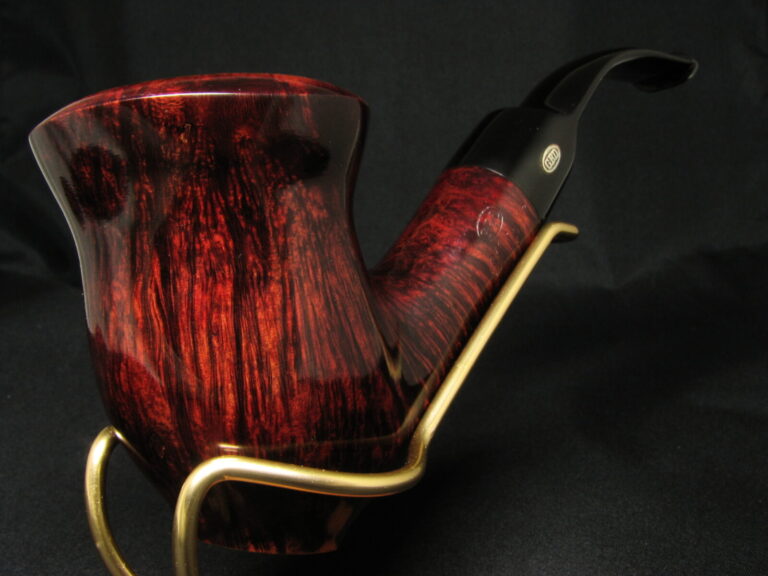
GBD (Flame Grain) Reject

GBD (Flame Grain) Reject

England

A rare, amazing and really lightly smoked example of GBD pipes art before the merge with Comoy’s. It’s difficult to say why the pipe was marked as a “Reject” – except a small darkening on the chamber’s bottom apparently there’s nothing.

The pipe markings are “Reject” and “GBD” (on the stem). The length is 12.8 cm, bowl’s hight is 4.6 cm. External and internal diameters of the bowl are 3.6 cm and 2.0 cm. The depth is 4.0 cm and this pipe weights 35gr. Briar, vulcanite stem, no filter.


Similar Posts

  • GBD Prince of Wales 8555

    England 1950-70s A very well made GBD pipe from the period before 1980 (in other words before the merge with Comoys under the Cadogans roof). Unique shape, great briar with amazing grain, transparent acrylic stem as a tribute to legendary perspex stems produced by GBD after the World War II – fantastic addition to every…

  • GBD Granitan 254

    England, 1950-70s A very stylish example of a creative approach and a bright imagination of carvers from the English GBD factory. The company was well known first of all as one of the oldest, most respected and one of the most prolific on model ranges, shapes and subbrands. But, as we can see, GBD artisans…

  • BEWLAY Extra freehand

    England, 1960-70s One of the most famous English tobacco shops, Bewlay & Co. Ltd was founded in 1870 at 49 W. Strand, London by Jewish family Elkan, who emigrated from the Netherlands. On the early stage the business was positioned as a tobacco retailer, Bewlay was one of the first, who started to sell cigars….

  • GBD Virgin 1451

    England, 1950-70s ​One of the top graded GBD pipes. The Virgin series followed their famous Pedigree, Prodigy and Straight Grain grades. The pipe was made in the 1970s latest, before the merge with Comoy’s by Cadogan. ​An extraordinary sample! Firstly, the pipe has a significantly extended stem, though it’s a Canadian (or a lumberman, to be…

  • GBD Garland II 9552

    England 1980-90s A very stylish GBD pipe made not such a long time ago – approximately in the 1980s. Nevertheless the original shape (named most frequently a “Calabash” or a “Bell”) is strongly reminescent of old good English calabash pipes. What an amazing continuity of traditions!

Leave a Reply

Your email address will not be published. Required fields are marked *