DUNHILL Shell 467, 1949

DUNHILL Shell 467, 1949

England, 1949

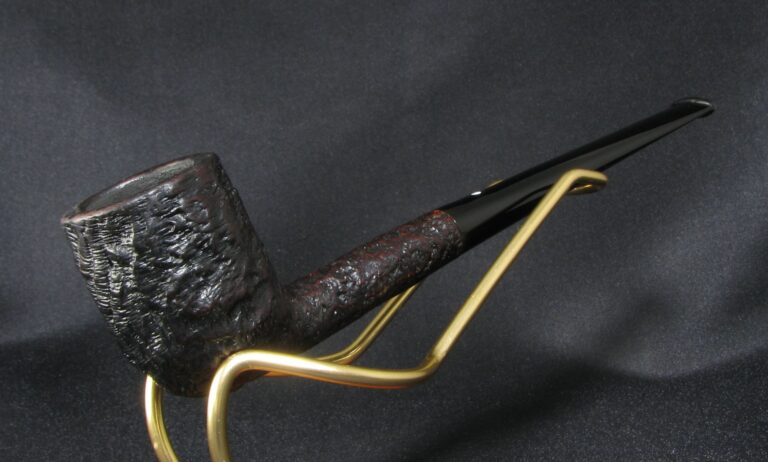
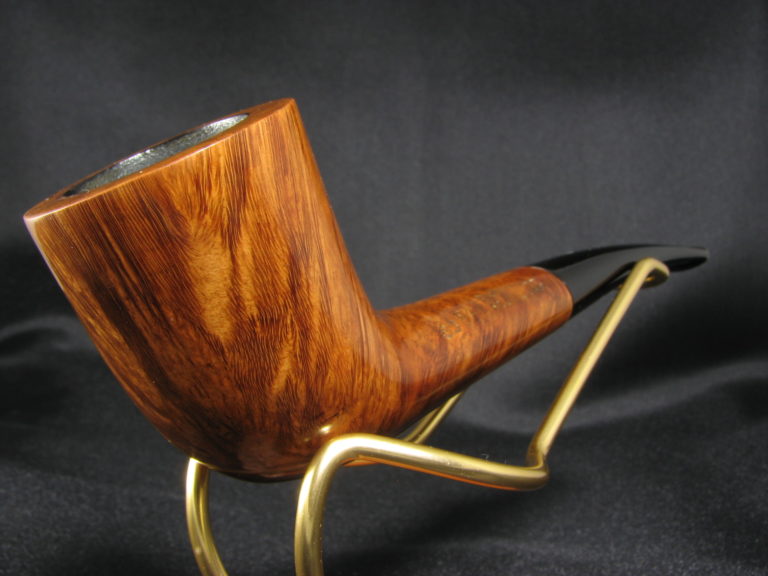
The sandblast finish is considered to be invented by Dunhill, at least this fact was confirmed with patents of 1917 – in Great Britain and 1920 – in the USA. From the very beginning Algerian briar was used for blasted pipes as it was much softer and provided deeper and more attractive finish. Although in 1960-70 the company had to use Corsican briar also, and in this case another Dunhill’s patent came into play – double processing (deep shell). It turned out that any material could provide the necessary result, you just need to have an appropriate technology near at hand. As an example – this pleasant pot shaped patent era pipe from 1949.

The pipe markings are “467”,”DUNHILL SHELL\ MADE IN ENGLAND 9 \ PATENT № 417574/34″. The length is 13.8 cm (5.43″), bowl’s height is 3.4 cm (1.34″). External diameter of the bowl is 3.2 cm (1.26″), internal diameter is 2.0 cm (0.79″). The depth is 3.0 cm (1.18″) and this pipe weights 23 gr. Briar, vulcanite stem (very slightly patched, you may identify the track under a bright light), no filter. The stem looks to be very slightly overbuffed near the shank.

Similar Posts

  • DUNHILL Cumberland 3103

    England, 2002 Even if Dunhill didn’t obtain a patent for usage of brindle ebonite for stems, their input in promoting of a new material and invention of a suitable and well memorable name for it is undoubted. The name was born in 1979, when a new series of sandblasted pipes with modern stems was christened…

  • DUNHILL Cumberland 52264, 1980

    England, 1980 The “Cumberland” series is relatively young in comparison to other lines – it was introduced in 1979 and named in honor of Cumberland Street – the street where production and warehouse capacities of the company existed comfortably for many years. But such brindle ebonite stems (“cumberland” stems – also a Dunhill’s invention!) make…

  • DUNHILL Dress 922

    England, 1993 Dunhill Dress pipes are relatively young; the series was introduced in 1973 and it is distinguished by the dark (in the most cases black) smooth finish. Despite dark stain hides natural briar grain the “Dress” pipes look luxury indeed!

  • DUNHILL Root Briar 83 (1968)

    England, 1968 Thanks to Dunhill’s clearness and punctuality – there’s everything crystal clear with this pipe dating and grading. This is the wonderful and lightweight Root briar pipe (the highest mass market grade) made in 1968. The shape number 83 is called a horn or a yacht – what you like more. Nice, amazing and…

  • DUNHILL Red Bark 197, 1970s

    England, 1970s Red Bark is perhaps the best-known and valued Dunhill series among other “retired”. The Red Bark pipes were produced not for a long time – from 1972 to 1987, and in fact, they are traditional sandblasted Dunhills, but smokers and collectors are still attracted by these pipes and their unusual staining. By the…

Leave a Reply

Your email address will not be published. Required fields are marked *