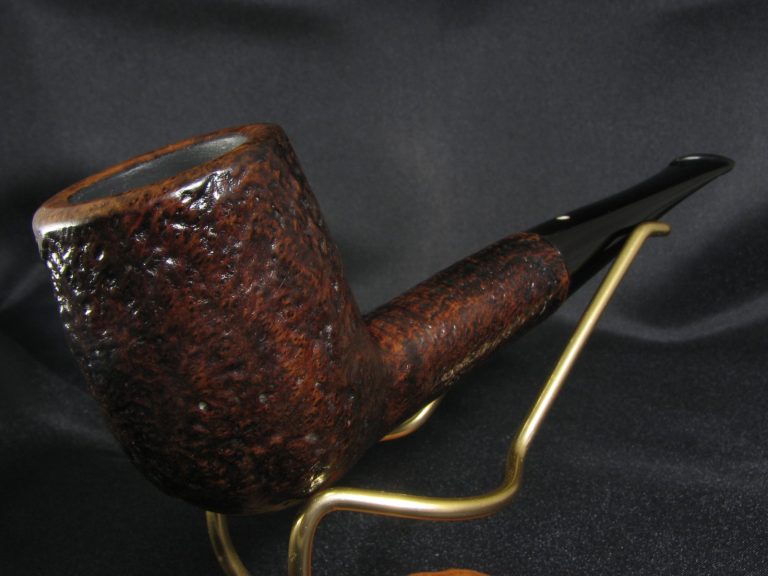
DUNHILL Dress 51033

DUNHILL Dress 51033

England, 2002

Dunhill Dress pipes are relatively young; the series was introduced in 1973 and is distinguished by dark (in the most cases black) smooth finish. Despite dark stain hides natural briar grain the “Dress” pipes look luxury indeed!

The pipe markings are “DUNHILL \ DRESS”, 51033″, “MADE IN \ ENGLAND 02”. The collar is stamped “AD” and “925”. ​The length is 15.1 cm (5.94″), bowl’s height is 5.2 cm (2.05″). External diameter of the bowl is 3.9 cm (1.54″), internal diameter is 2.0 cm (0.79″). The depth is 4.3 cm (1.69″) and this pipe weights 45 gr. Briar, vulcanite stem (very lightly patched, you ma identify the trace under a bright light), no filter. The chamber has normal smoked wear not excluding some roughness but without any critical issues.

Similar Posts

  • DUNHILL Root Briar 4108

    England, 1978 Initially Dunhill didn’t pay any special attention to a grain of briar. Perhaps, the public opinion had not been ready yet to a “straight grain” and material of early Bruyere pipes didn’t differ by a remarkable grain. But in 1931 Root Briar series was started. The pipes were made of Corsican briar, wonderful…

  • DUNHILL Bruyere 60

    England, 1960s In the beginning Dunhill created Bruyere. And several years (1910-1917) it was the single brand made by the company of a firm and dense Calabrian briar. And though pre WWII “bruyeres” were marked just by a letter “A” instead of model, the Bruyere series is the one of the oldest long-livers not only…

  • DUNHILL Shell Briar 120

    England, 1962-63 It seems the pipe has two year suffixes – one (“2”) was printed after the word “England” and the second (“3”) is located a bit below it. A new year transition pipe? 🙂 Despite the Group Size 4 the pipe really impresses with its dimensions and the shape – a very stylish large…

  • DUNHILL Cumberland 3103

    England, 2002 Even if Dunhill didn’t obtain a patent for usage of brindle ebonite for stems, their input in promoting of a new material and invention of a suitable and well memorable name for it is undoubted. The name was born in 1979, when a new series of sandblasted pipes with modern stems was christened…

  • DUNHILL Shell 467, 1949

    England, 1949 The sandblast finish is considered to be invented by Dunhill, at least this fact was confirmed with patents of 1917 – in Great Britain and 1920 – in the USA. From the very beginning Algerian briar was used for blasted pipes as it was much softer and provided deeper and more attractive finish….

Leave a Reply

Your email address will not be published. Required fields are marked *