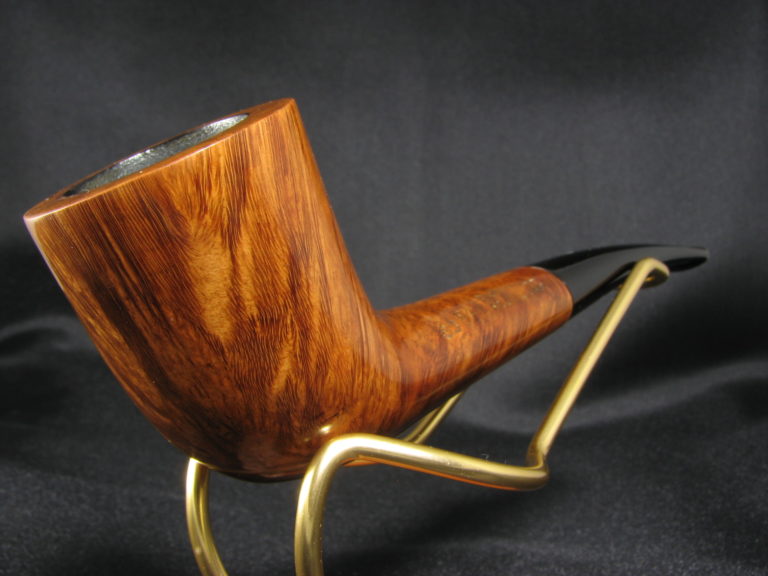
DUNHILL Bruyere 333

DUNHILL Bruyere 333

England, 1960s

First of all, this is the Dunhill pipe, no need to perform long explanations. Secondly, it has a very popular, respected and cool smoked canadian shape. Thirdly, it has no year suffix what is very rare for the post WWII Dunhill pipes, experts say it is the 1960 Dunhill most probably. And fourthly, the pipe comes with an original Dunhill box, which sadly is not in a perfect condition after 55 years storage (a little bit squashed), but makes the pipe even more valuable and collectable. 

​The pipe markings are “DUNHILL BRUYERE”, “333 F/T”, “MADE IN \ ENGLAND”, “(3) A”. The length is 13.8 cm (5.43″), bowl’s height is 3.8 cm (1.5″). External and internal diameters of the bowl are 3.1 cm (1.22″) and 1.8 cm (0.71″). The depth is 3.4 cm (1.34″) and this pipe weights 22 gr. Briar, vulcanite stem, no filter. The chamber has been protected with the break-in coat.


Similar Posts

  • DUNHILL Shell Briar 591

    England, 1956 An absolutely amazing highly collectable full bent (“Oom Paul”) pipe created by Dunhill carvers in 1956. The pipe is completed with two newly made stems: the canonical black vulcanite stem with the white spot according to Dunhill standards and the modernistic inversion white acrylic stem with the black spot. So you may choose…

  • CHACOM Lupenrein 309

    France “Lupenrein” is a German word meaning “flawless”, “perfect”, “clean” (f.e. “clean diamond”) and we really couldn’t identify any issues with briar. Also interesting that the number 309 for such canadian shape pipes was widely used by Comoy’s during its best times and we suspect even refined experts couldn’t distinguish the pipe and English made…

  • DUNHILL Cumberland 3103

    England, 2003 The “Cumberland” series is relatively young in comparison to other lines – it was introduced in 1979 and named in honor of Cumberland Street – the street where production and warehouse capacities of the company existed comfortably for many years. But such brindle ebonite stems (“cumberland” stems – also a Dunhill’s invention!) make…

  • DUNHILL Cumberland 31351

    England, 1981 Even if Dunhill didn’t obtain a patent for usage of brindle ebonite for stems, their input in promoting of a new material and invention of a suitable and well memorable name for it is undoubted. The name was born in 1979, when a new series of sandblasted pipes with modern stems was christened…

  • DUNHILL Dress 51033

    England, 2002 Dunhill Dress pipes are relatively young; the series was introduced in 1973 and is distinguished by dark (in the most cases black) smooth finish. Despite dark stain hides natural briar grain the “Dress” pipes look luxury indeed!

Leave a Reply

Your email address will not be published. Required fields are marked *