DUNHILL Bruyere 33

DUNHILL Bruyere 33

England, 1935-52

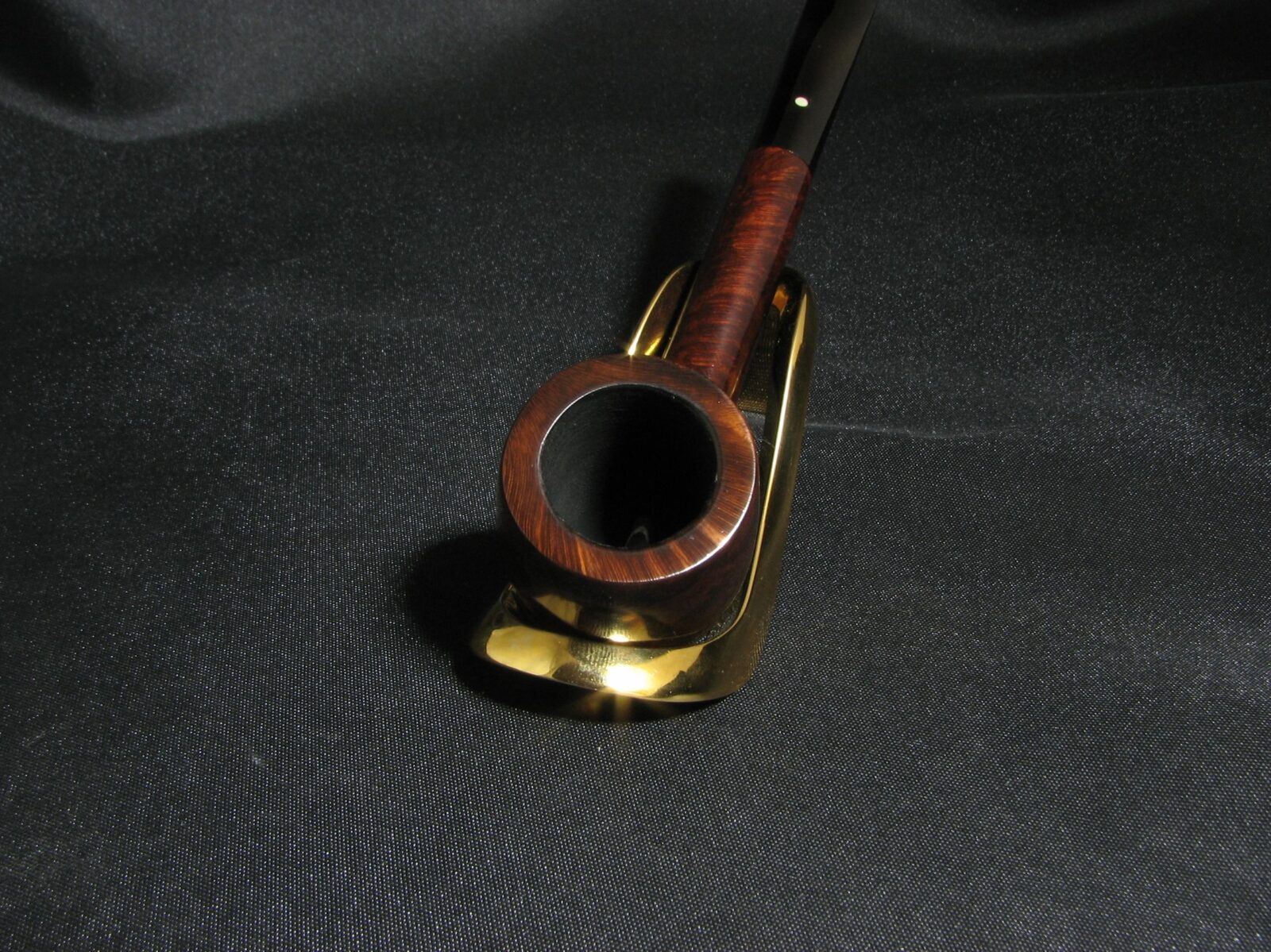
This Dunhill pipe came to us with the noticeably chewed mouthpiece and very faint nomenclature, and of course it was hardly possible to make it clearer, the challenge was to save at least a few more or less visible symbols during the restoration. So you may need very bright light and a good magnifying glass to read the shape number 33 and DUNHILL above BRUYERE on the left side and “(2) A”, “PAT…..4” on the right side. The pipe is also equipped with  an inner tube, the end of it is a bit smashed , but we saved the stamping “…417574”.  Fortunately there were only a few patents registered by Dunhill with the last number “4” – the best known are 417574 (1935-1942) and 417574/34 (1942-52), so we may be sure the pipe is from the period of 1935-52.

The pipe markings are “33”, “DUNHILL \ BRUYERE”, “PAT……..4”, “(2) A” on the bowl and “…417574” on the tube. The length is 13.2 cm (5.2″) and the bowl’s height is 3.8 cm (1.5″). External diameter of the bowl is 3.0 cm (1.18″), internal diameter is 1.8 cm (0.71″). The depth is 3.4 cm (1.34″) and this pipe weighs 23 gr. Briar, vulcanite stem (carefully patched on both sides near the button – you may see the trace under a good light), inner tube.  

Similar Posts

  • DUNHILL Tanshell 63

    England, 1967 It seems we talk about Charatan’s pipes very frequently. This Charatan’s, another Charatan’s, “Dunhill killer”… At the same time Dunhill’s pipes successfully beat all competitors and remain at the top of glory, popularity and commercial success.

  • DUNHILL Bruyere 60

    England, 1960s In the beginning Dunhill created Bruyere. And several years (1910-1917) it was the single brand made by the company of a firm and dense Calabrian briar. And though pre WWII “bruyeres” were marked just by a letter “A” instead of model, the Bruyere series is the one of the oldest long-livers not only…

  • DUNHILL Shell 21111

    England, 1978 The sandblast finish is considered to be invented by Dunhill, at least this fact was confirmed with patents of 1917 – in Great Britain and 1920 – in the USA. From the beginning Algerian briar was used for blasted pipes as much softer and providing deeper and more attractive finish. Although in 1960-70…

  • DUNHILL Shell 467, 1949

    England, 1949 The sandblast finish is considered to be invented by Dunhill, at least this fact was confirmed with patents of 1917 – in Great Britain and 1920 – in the USA. From the very beginning Algerian briar was used for blasted pipes as it was much softer and provided deeper and more attractive finish….

  • DUNHILL Root Briar 2000

    England, 2000 Let’s call it a “millenium pipe”. This attractive decent size (group 5) top grade Dunhills Root Briar pipe doesn’t have a shape number at all, but it says clearly it was made exactly in 2000. We assume the shape number should be 5113 (bent apple), but absence of this number makes the pipe…

  • DUNHILL Root Briar 4108

    England, 1978 Initially Dunhill didn’t pay any special attention to a grain of briar. Perhaps, the public opinion had not been ready yet to a “straight grain” and material of early Bruyere pipes didn’t differ by a remarkable grain. But in 1931 Root Briar series was started. The pipes were made of Corsican briar, wonderful…

Leave a Reply

Your email address will not be published. Required fields are marked *