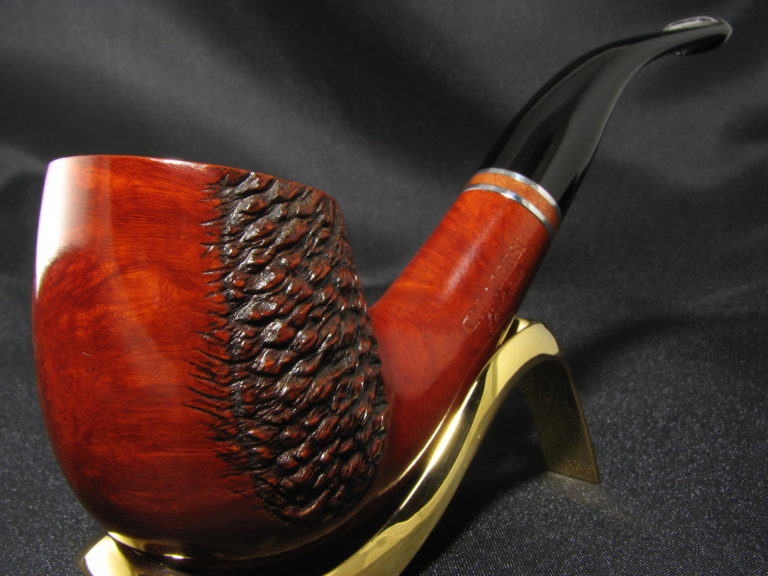
CALABRESI L'Artigiano rhodesian

CALABRESI L’Artigiano rhodesian

USA, 1980-90s

An exquisite, nicely styled (and still unsmoked!) pipe made by Thomas Cristiano. Tomas Cristiano was the Italian by origin, his family emigrated to the USA in 1968 and several generations of Cristiano are involved into production and marketing of wonderful briar pipes. Thomas began at the S.M. Frank & Company factory – one of the “briar giants” of America, very quickly he made an outstanding career and started own production of the brands T. Cristiano and Calabresi. Thomas’s pipes are in Italian way graceful and expressive and in American way well balanced in terms of a price / quality ratio.

The pipe markings are “CALABRESI \ l’artigiano”, “ITALY”, “C”, “METAMORFOSI \PAT. PEND”. The length is 14.2 cm (5.59″), bowl’s height is 4.1 cm (1.61″). External diameter of the bowl is 4.3 cm (1.69″), internal diameter is 2.0 cm (0.79″). The depth is 3.4 cm (1.34″) and this pipe weights 42 gr. Briar, vulcanite stem, 9 mm filter. The chamber has been protected with a break-in coat. Additionally the pipe can be completed with a 9 mm adapter upon your request.

Similar Posts

  • L&H STERN Bradford

    USA An unsmoked pipe born in a house with a view on Manhattan! L&H stern was established in 1911 and initially resided on Manhattan, but moved to Brooklyn in 1920. Except the location, popularity of L&H Stern Inc. was caused by high quality pipes of top series, such as Sterncrest, and the status of the…

  • BBB Best Make 602

    England, unsmoked An unsmoked BBB Best Make pipe from the second half of the XX century. After ancient times silver hallmarks BBB didn’t apply any signs of a year or at least of a period of production, therefore we can’t say more specific. The pipe did require some efforts: the shank was stopped with a…

  • ORLIK Hurricane 21479

    England, 1980-90s The patent 2135179 (https://patents.google.com/patent/US2135179) for a “hurricane type” pipe with the integrated wind cap was issued to Frederick Hudes in 1938 in the USA. So it’s the most probably an American invention. But contrary to others numerous novelties this idea was successfully adopted not only by American manufacturers such as Mastercraft (“Sparkproof “),…

Leave a Reply

Your email address will not be published. Required fields are marked *