BARLING'S Guinea Grain SM

BARLING’S Guinea Grain SM

England, 1950s

Middlesbrough (Middlesbrough or Middlesbro) is a town in the north-east of England. It is known as a seaport, an industrial centre and the homeland of the musician Chris Rhee. In 1907 Lady Florence Bell, the wife of the local industrialist Hugh Bell, wondered why people spend so much time in pubs? As it was found that the frequent reason was not in thirst for alcohol but just in the desire to warm up somewhere in the crude and cold northern evenings. As an alternative Sir Hugh and Lady Bell based a winter garden. It was not just a collection of plants, but as would say today, the place of socialising and recreation – here people could come to get warm, have a rest, to play games such as cards or billiard, food and drinks were offered too.

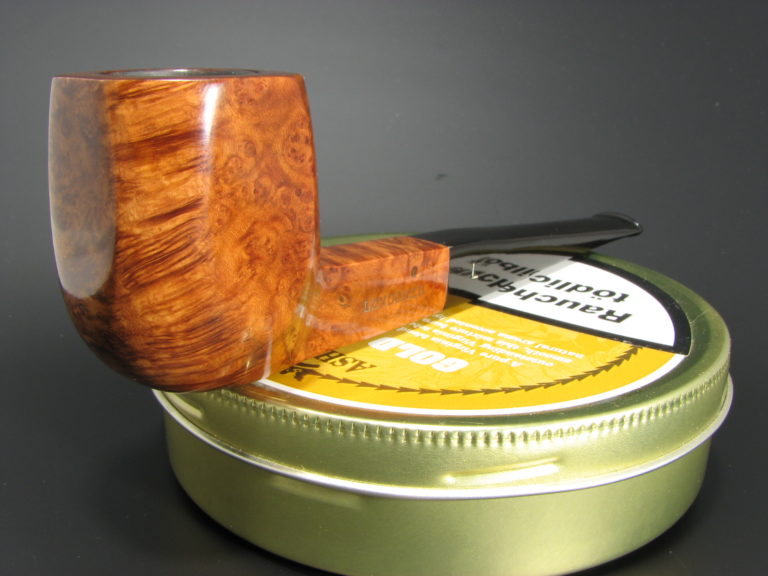
Alcohol was forbidden. But there seemed to be a good tobacconist, a very decent one. So decent that, for example, in 1950s (the still slightly visible stamp “Barling Design” on the stem points namely to this period) it was possible to buy a Barling pipe of the highest grade made for the order of the Winter Garden. This one, for example.

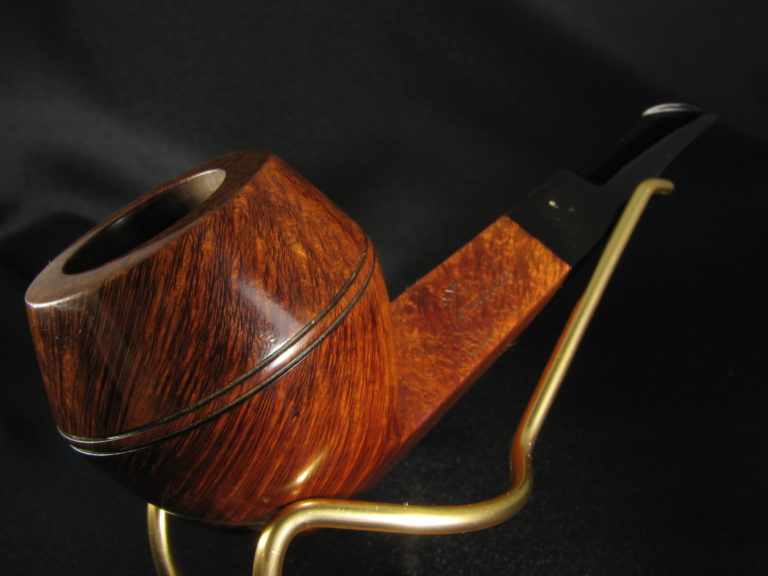
​The pipe markings are “Barling’s \ GUINEA GRAIN REG”, “WINTER GARDEN \ MIDDLESBRO'”, “SM”. The stem has also the slightly visible crossed Barling logo and the marking “Barling Design”. The length is 13.3 cm (5.24″), bowl’s height is 3.4 cm (1.34″). External diameter of the bowl is 3.2 cm (1.26″), internal diameter is 1.9 cm (0.75″). The depth is 2.8 cm (1.1″) and this pipe weights 21 gr. Briar, vulcanite stem (a little bit patched in the button are, you may notice that under a bright light), no filter. There were a few scratches and chips patched on the bowl during the restoration.

Similar Posts

  • BARLING Londoner 326s

    England, 1960s After the acquisition of the Barling family business by Imperial Tobacco the production of pipes has been moved to other countries such as Italy, Denmark and France. Our pipe is quite rare because from one hand it also belong to the period just after the acquisition but on the other hand it has…

  • BARLING’S MAKE Ye Olde Wood 447 EXEL

    England, 1950s ​A decent size traditional English lovat pipe made at Barling’s family factory between 1946 and 1962, i.e. during the pre-transition period. The arched BARLING’S MAKE logo is already of a full size, larger than before WWII. Additionally there’s a three-digit shape number (447). The logo on the original stem hasn’t remained well visible…

  • BARLING Londoner 494

    England, 1960-70s ​The Londoner pipes were made in 1960-70s both in England and in Danmark (including Erik Nordning pipe factory). There’s no COM stamping on the pipe therefore we can’t say more definitely. But it’s really a great and amazing example of Barling production from that time! The section of the bowl is not an…

  • BARLING Londoner 519S

    England, 1960s The Londoner line was introduced after the acquisition of the Barling family business by Imperial Tobacco. However, after some time, the production of most pipes, including the Londoner series, was moved to other countries such as Italy, Denmark, and France. Therefore, our pipe is quite rare because it has been made still in…

  • BARLING King 6229 T.V.F.

    England, 1960s This large sandblasted apple is already a corporate era Barling pipe, the most experienced experts assign the King series with such nomenclature to 1962-1970. Although these “corporate” Barlings don’t cost hundreds of dollars the pipes were carved very skillfully and with all possible respects to 150-year Barling family pipe making tradition.

  • BARLING Londoner 6635

    England, 1970s The Londoner line was introduced already after the acquisition of the Barling family business by Imperial Tobacco. But after some time the production of most pipes including the Londoner series was moved to other countries such as Italy, Denmark and France. Therefore our pipe is quite rare because it has been made still…

Leave a Reply

Your email address will not be published. Required fields are marked *